
Cleanroom Risk
For contamination introduced during ordinary handling.
Choose your level of protection
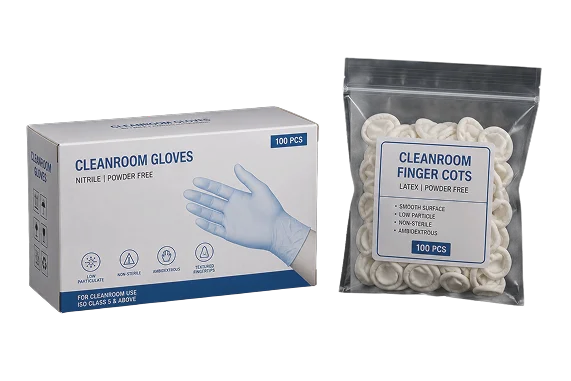
BASIC PROTECTION
- —Gloves
- —Finger Cots
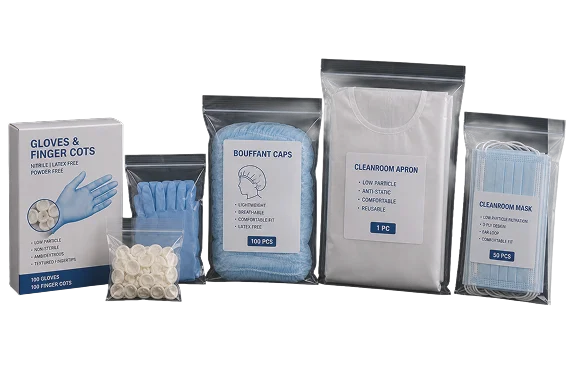
INDUSTRIAL PROTECTION
- —Gloves
- —Finger Cots
- +Bouffant Caps
- +Cleanroom Apron
- +Mask
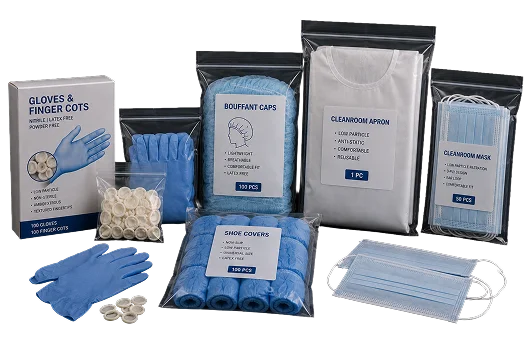
CRITICAL PROTECTION
- —Gloves & Finger Cots
- —Bouffant Caps
- —Cleanroom Apron
- —Mask
- —Shoe Covers
WHERE CLEANROOM DAMAGE ACTUALLY SHOWS UP
Skin contact, loose hair, or ordinary breath can introduce contamination that's invisible at the time
Contamination doesn't always stop a component from working immediately. It can cause failure only once the part is in active use.
The component passes every visual check on your floor, and the issue surfaces only after it's already in service.
WHICH LEVEL DO YOU NEED?
Who This Protects
Common Questions
Q: Are standard static shielding bags certified for ISO Class 5 cleanrooms?
A: No. Standard bags can shed particles or outgas volatile organic compounds (VOCs) that contaminate silicon wafers. ISO Class 5 packaging requires ultra-pure, double-bagged cleanroom-certified films produced in cleanroom environments with zero slip agents or amides.
Q: What outgassing metrics are critical for optoelectronic tray materials?
A: We track Total Mass Loss (TML) and Collected Volatile Condensable Material (CVCM) under ASTM E595. For optical and laser sensors, materials must maintain TML <1.0% and CVCM <0.1% to prevent fogging and lens contamination.
Related Protection Risks
Also dealing with static risk?
See Static Risk→Also dealing with moisture risk?
See Moisture Risk→Not sure which level fits your cleanroom risk?
Share SMT/EMS details and our custom design engineers will specify target levels for your line components.