
Moisture Risk
For moisture trapped in your component, anywhere from storage to delivery.
Choose your level of protection
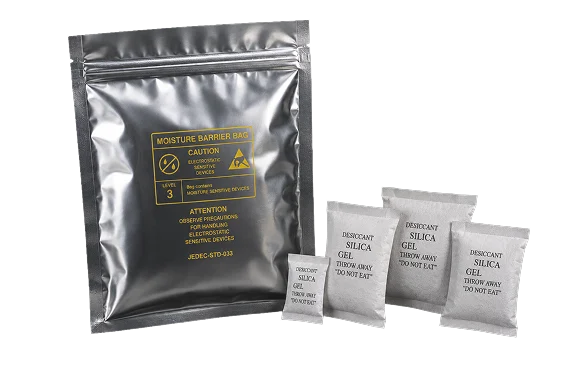
BASIC PROTECTION
- —Moisture Barrier Silver Bags
- —Silica Gel
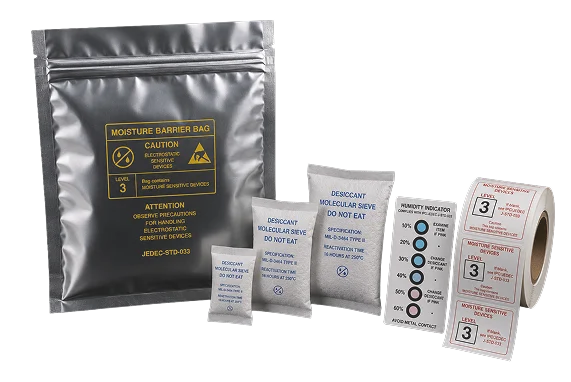
INDUSTRIAL PROTECTION
- —Moisture Barrier Silver Bags
- —Molecular Sieve
- +Humidity Indicator Card
- +Moisture Label
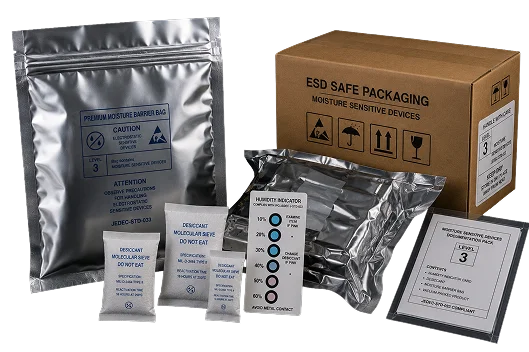
CRITICAL PROTECTION
- —Premium MBB
- —Molecular Sieve
- —Humidity Indicator Card
- +Vacuum Packing
- +Export Carton
- +Moisture Documentation
WHERE MOISTURE DAMAGE ACTUALLY SHOWS UP
Moisture-sensitive components absorb humidity from the air around them, even inside a warehouse. There is no visible sign that this has happened.
The component is not damaged by moisture alone. It is damaged when heat is applied during reflow, and the moisture inside turns to steam.
The failure appears during assembly or after, once the component has already left production floor.
WHICH LEVEL DO YOU NEED?
Who This Protects
Common Questions
Q: How long can components remain outside of moisture barrier bags?
A: Based on IPC/JEDEC J-STD-033, the allowable floor life of components after removal from a Moisture Barrier Bag (MBB) depends on their Moisture Sensitivity Level (MSL), ranging from unlimited (Level 1) to as little as 4 hours (Level 5a) in standard factory conditions (≤30°C/60% RH). Once exceeded, baking is required before reflow.
Q: What is the recommended shelf life for desiccants used in vacuum packing?
A: Active clay or silica gel desiccants remain fully effective for up to 12 months when stored in original, unopened airtight containers. Once packed inside a heat-sealed Moisture Barrier Bag (MBB), they protect the dry environment for a minimum shelf life of 12 to 24 months, provided the bag's integrity is not compromised.
Related Protection Risks
Also dealing with storage & preservation risk?
See Storage & Preservation Risk→Also dealing with cleanroom risk?
See Cleanroom Risk→Not sure which level fits your moisture risk?
Share SMT/EMS details and our custom design engineers will specify target levels for your line components.