esd-packaging

The Monsoon Paradox: Why India's Rainy Season Is the Most Dangerous Time for Electronics on the Production Floor

India's monsoon season doesn't just bring humidity — it creates a hidden ESD trap inside air-conditioned factories. Learn the science behind why electronics fail after the rains, backed by research and data.

Sobin Johnson16 min read
The Monsoon Paradox: Why India's Rainy Season Is the Most Dangerous Time for Electronics on the Production Floor
Disclaimer: This article is intended as an educational resource for electronics manufacturers, procurement managers, and production floor engineers. All cited figures are sourced from peer-reviewed research, industry standards bodies, and published studies. References are included at the end of each section and consolidated at the bottom of this article.

Introduction: The Season Everyone Gets Wrong

Ask any production manager in Nagpur or Pune what time of year they worry about ESD damage to components, and the answer is almost always the same: "Winter, maybe. Or summer when it's dry."

Almost no one says monsoon.

That's the paradox this article is about.

Between June and September, when humidity outside climbs above 80%, the shop floor feels safer from static. The air is thick with moisture. Staff stop noticing sparks. ESD wristbands get worn less diligently. Anti-static packaging sits unopened at the dock because "the air is humid anyway."

And then, three to six months later, field failures spike. Warranty returns come in. Rework costs climb. Procurement managers scramble to figure out what went wrong with the batch that passed QC.

What went wrong happened in June. On the production floor. Inside a perfectly air-conditioned room.

This article explains the physics, the data, the standards, and the decision framework that production managers and procurement heads at India's Tier 2 and Tier 3 EMS units and PCB assemblers need to understand before the next monsoon cycle begins.


Section 1: The Scale of the Problem — Before We Get to the Season

Before discussing monsoon specifically, it's worth establishing just how large the ESD problem is globally.

The ESD Association (ESDA), the primary standards body for electrostatic discharge in electronics manufacturing, has published the following:

"Industry experts have estimated average product losses due to static to range from 8 to 33%. Others estimate the actual cost of ESD damage to the electronics industry as running into the billions of dollars annually."
— ESD Association (ESDA) [1]

The ESD Association further estimates that 25% of all electronics damaged for unknown reasons can be attributed to ESD, with global industry losses estimated at $5 billion USD per year [2].

Electronic failures resulting from ESD are the 3rd highest cause of device-related yield and reliability problems globally, and as device geometries shrink, sensitivity increases [3].

Two Types of ESD Damage: One Is Far More Dangerous

TypeDescriptionDetectabilityTypical Cost
Catastrophic failureImmediate, complete circuit breakdown — metal melt, oxide punch-throughDetected at QC; scrapped before shipmentLow (caught early)
Latent damageMicro-junction degradation, weakened oxide layer; device passes QCFails in the field weeks or months laterVery high — warranty, returns, reputation

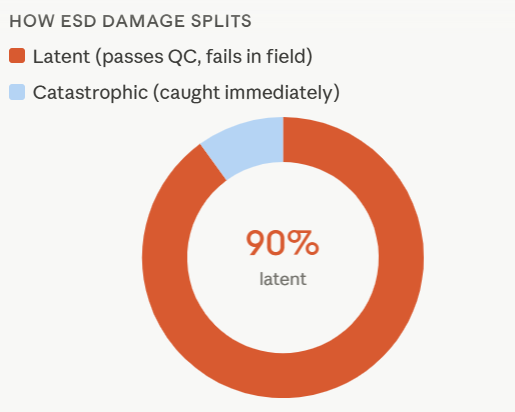
Up to 90% of ESD-related failures are latent — not catastrophic — according to industry studies [4]. This means the majority of ESD damage is completely invisible during manufacturing QC. The board ships. The customer installs it. And somewhere between 4 weeks and 6 months later, it fails.

For Indian EMS units and PCB assemblers targeting export markets — where a product that fails in the field carries the weight of both warranty costs and brand damage — latent ESD is the silent multiplier of cost.

Latent ESD damage has been shown to reduce mean time between failures (MTBF) by up to 50% [5].


Section 2: The Physics of Static Electricity and Humidity

Why Humidity Matters at All

Static electricity accumulates when two materials come into contact and then separate — called the triboelectric effect. Walking across a floor, pulling a PCB from its tray, removing a component from packaging, even an operator adjusting their workstation: all of these generate electrostatic charge.

Under normal indoor conditions, this charge would dissipate through the ambient moisture in the air. Water vapour is a natural conductor. When enough of it exists in the air, charge bleeds away passively before it can accumulate to dangerous levels.

When the air is dry, there is no such path. Charge builds. And when it discharges — sometimes in nanoseconds — it flows through whatever conductive path is nearest. Often, that's the thin gate oxide of an IC, a bond wire, or a MOSFET junction.

Some components can be destroyed by discharges as low as 30 volts — well below any human sensory threshold (human perception of static discharge begins around 1,000–3,000 V depending on the standard consulted) [6] [7].

The Humidity-Voltage Relationship: The Numbers

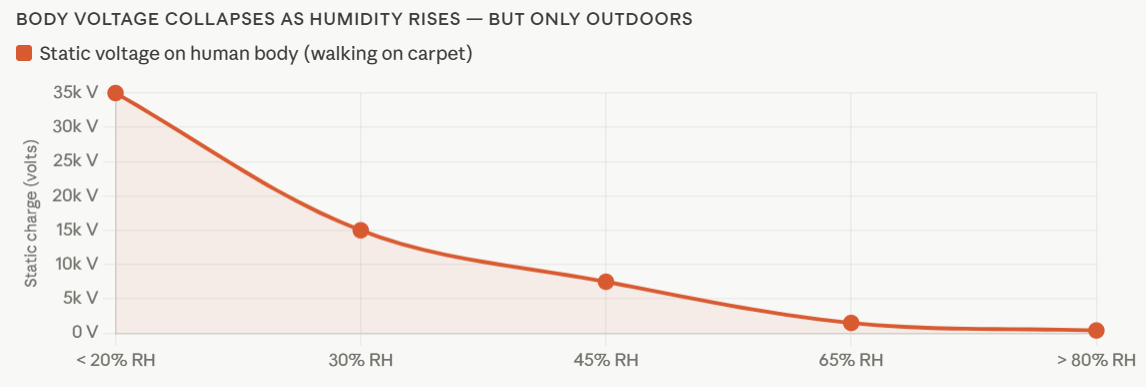
The relationship between relative humidity (RH) and the maximum static voltage a person can accumulate has been extensively measured. The following figures are widely cited from industry and defence standards:

Relative Humidity (RH)Max body voltage (walking on carpet)Max body voltage (walking on vinyl tile)
< 20%~35,000 V~12,000 V
25–30%~15,000 V~5,000 V
40–50%~7,500 V~3,000 V
65–70%~1,500 V~500 V
> 80%< 500 V< 250 V

Sources: ESDA ESD Handbook ESD TR20.20-2008; USPTO Patent 12563710 (Device for protection against ESD); ESD TR20.20 section 5.3.16 Humidity [8]

This data tells a simple story: high outdoor humidity dramatically reduces static buildup potential. And this is exactly what production floors in India experience during the monsoon — outdoors.


Section 3: The Monsoon Paradox — The Trap Inside the Factory

Here is where the conventional assumption breaks down completely.

The Air Conditioning Effect

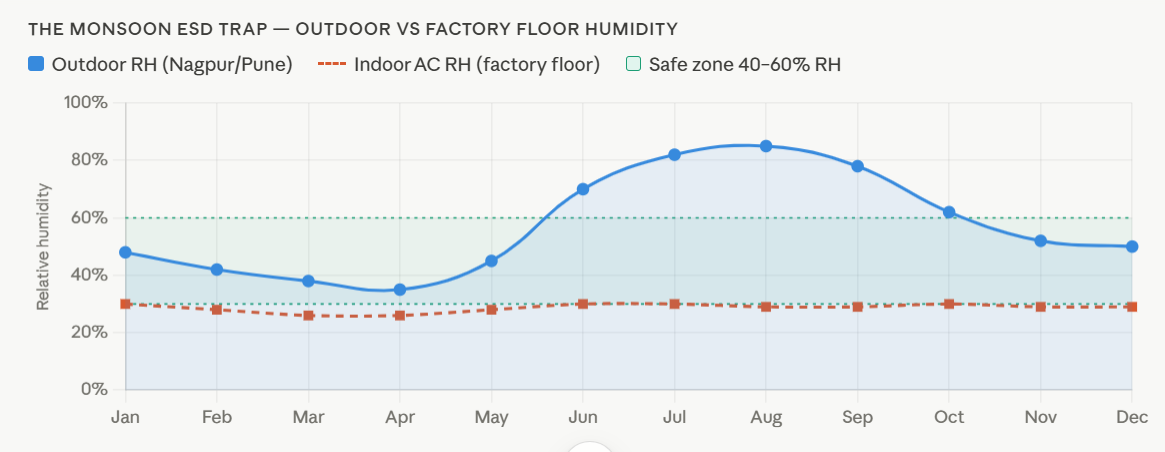
When outdoor humidity in Nagpur or Pune climbs to 80–90% RH during peak monsoon, production floors do what any responsible electronics manufacturer should do: they run their air conditioning systems aggressively. Temperature control prevents soldering defects, protects component storage, and keeps operators comfortable.

But air conditioning does more than cool. It dehumidifies.

Hot, humid outdoor air is drawn into the building and cooled. When air cools, its capacity to hold moisture drops dramatically — but the absolute moisture content stays the same or decreases. The result: indoor relative humidity can drop well below 40% RH even while outdoor humidity is above 80%, especially in sealed, climate-controlled environments.

This creates what we call the Monsoon ESD Trap:

Outdoor Humidity: 85% RH → Low ESD risk perception

Indoor AC Environment: 25–35% RH → HIGH ESD risk (actual) Operator Behaviour: Relaxed ESD protocols (based on outdoor feel) Result: Maximum ESD exposure with minimum ESD awareness

The ESD Handbook (ESD TR20.20-2008) states clearly:

"For most situations, 30 to 70% RH is considered the appropriate range. Relative humidity above 30% in ESD protective areas is desirable... Any circumstance that results in a low relative humidity will permit a greater accumulation of electrostatic charges."
— ESD TR20.20-2008, Section 5.3.16 [9]

The international standards-aligned safe zone is 40–60% RH, with a functional floor of 30% RH. Below 40%, risk increases significantly. Below 20%, the risk is extreme.

Aggressively air-conditioned Indian factory floors during monsoon regularly fall into the 25–35% band — below the safe floor — while operators feel that the rainy season means they're protected.

The Behavioural Compounding Factor

The Monsoon ESD Trap isn't just physical. It's behavioural:

  • ESD wristbands go unworn because the air "feels" humid
  • Anti-static bags are left open on benches
  • Grounding checks become less frequent
  • Components are transported in standard polybags from the dock to the line
  • Buffer stock received from distributors during rainy season sits on open shelves without EPA (Electrostatic Protected Area) conditions
Each of these behaviours is understandable. Each of them is dangerous. And because the damage is latent — undetectable at QC — the connection between monsoon-season handling and post-monsoon field failures is rarely made.


Section 4: What ESD Actually Does to a PCB Component

The Mechanism of Damage

When an ESD event occurs, a nanosecond-duration pulse of current passes through the component. The energy involved can seem small — but relative to the size of modern semiconductor features, the analogy offered by the German Federal Patent Office is apt:

"In proportion to the size of the component, the energy of a static discharge behaves like the energy of a lightning strike in a tree."
— USPTO Patent 12563710 [10]

The physical damage mechanisms include:

1. Metal melt / metallization damage: Current flow at the contact point exceeds the thermal limit of the metallisation, melting or fusing conductor traces.

2. Gate oxide punch-through: In MOSFETs and ICs, the thin dielectric oxide layer between the gate and channel is breached. A conductive path forms where there should be insulation. This is often the mode of latent failure — the device continues to function, but the oxide is now compromised.

3. Junction breakdown: Reverse bias breakdown across a PN junction, particularly in sensitive bipolar transistors.

4. Bond wire damage: Partial melting of bond wires connecting the die to the package, leaving a weakened but functional connection that eventually fails under thermal cycling.

Sensitivity Classification (HBM Model)

The Human Body Model (HBM) — standardised under ANSI/ESDA/JEDEC JS-001 — simulates the discharge from a human fingertip to a component. It models the human body as a 100 pF capacitor discharging through 1,500 Ω into the device under test [11].

IEC 61340-5-1, the international ESD control standard, covers components with withstand voltages:

  • ≥ 100 V (HBM) — General ESD sensitive components
  • ≥ 200 V (CDM — Charged Device Model)
  • ≥ 35 V for isolated conductors
Components with lower withstand voltages require additional control measures [12].

As process nodes have shrunk — 28nm, 14nm, 7nm — gate oxide thicknesses have decreased proportionally, and HBM thresholds have dropped. The EOS/ESD Technology Roadmap projects device sensitivities below 125V CDM for the most sensitive devices, and this trend continues [13].

Component TypeApproximate HBM Sensitivity
MOSFETs (thin gate oxide)100 – 200 V
Microcontrollers (advanced node)250 – 500 V
GaAs ICs100 – 300 V
BJT transistors300 – 7,000 V
Resistors, capacitorsGenerally robust
Schottky diodes300 – 2,500 V
SCRs1,000 – 2,500 V

Source: ESD Association classification data; IEEE Xplore — ESD Research of SCR Devices Under Harsh Environments, Lin & Lin, MDPI Materials, 2023 [14]


Section 5: The Indian Context — Why This Matters More Here Than Anywhere

India's Electronics Surge Makes the Stakes Higher

India's electronics manufacturing sector has undergone a fundamental shift:

  • Electronics production grew from ₹1.9 lakh crore in 2014–15 to ₹11.32 lakh crore in 2024–25 — a roughly 6x increase [15]
  • Electronics exports jumped 8x — from ₹38,000 crore in 2014–15 to ₹3.26 lakh crore in 2024–25, now the third-largest export category [16]
  • India's EMS market has grown to ~$40–45 billion in FY25 and is projected to reach $150 billion by FY30 at a 31% CAGR [17]
  • PCB assembly (PCBA) is projected to grow at 30% CAGR, driven by both domestic OEM supply and export demand [18]
This growth is happening largely in cities like Pune, Bengaluru, Chennai, and increasingly Nagpur — during a period when the precision expectations from global customers are rising sharply. Export markets — North America, Europe, Southeast Asia — will not tolerate latent ESD failures. Their quality protocols catch what Indian domestic-focused QC often misses.

For India's Tier 2 and Tier 3 EMS units and PCB assemblers, the combination of higher export targets, thinner geometry components, and inadequate monsoon-season ESD protocols is a collision point that few have formally acknowledged.

The Nagpur–Pune Belt: Climate Data

Both cities experience India's standard monsoon cycle: June–September sees outdoor humidity regularly exceed 75–85% RH. Both cities also host EMS units, PCB assemblers, and component manufacturers in industrial parks that rely on centralised cooling infrastructure — the exact scenario that creates the Monsoon ESD Trap.

Approximate indoor RH ranges in climate-controlled manufacturing environments during different seasons:

Season          Outdoor RH    Typical Indoor AC RH    ESD Risk Level

────────────────────────────────────────────────────────────────────── Pre-monsoon 30–45% 25–40% HIGH (recognised) Monsoon (peak) 75–90% 25–40% HIGH (unrecognised) Post-monsoon 50–65% 35–50% MEDIUM Winter (Dec) 30–50% 20–35% HIGH (partially recognised)

The monsoon column — HIGH risk, unrecognised — is the problem statement.


Section 6: The Standards That Define Compliance

For Indian manufacturers targeting export markets — whether aerospace, automotive, telecom, or consumer electronics — ESD compliance is not optional. Two primary standards define global requirements:

ANSI/ESD S20.20

The American National Standard for ESD control programmes in manufacturing. Widely required by US and European OEM customers. Covers:

  • EPA (Electrostatic Protected Area) design and management
  • Grounding and bonding requirements
  • Personnel grounding (wristbands, footwear)
  • Packaging and material requirements
  • Humidity and environmental controls
  • Training requirements

IEC 61340-5-1

The international (IEC) equivalent, widely recognised in European and global supply chains. The EN 61340-5-1 edition 2.0 (2016) is the current version. Both standards can be certified simultaneously for global market access [19].

Key Environmental Requirements Under Both Standards

Both ANSI/ESD S20.20 and IEC 61340-5-1 reference the ESD Handbook for environmental guidelines. The critical parameter:

Relative humidity in EPA zones: 30–70% RH, with 40–60% RH as the operational target.

Below 30% RH, ionisation is specifically recommended as a supplementary control [20].

Monsoon-season AC environments that drop below 30–35% RH are out of compliance with both standards, regardless of whether a wristband is being worn.


Section 7: Monsoon-Season ESD Risk — A Checklist Framework

The following is a practical checklist framework for production and procurement teams to assess and close monsoon-season ESD risk. This is not theoretical — it reflects the physical reality of the indoor climate during the rainy season.

A. Environmental Controls

  • Is humidity being measured? Not estimated — actively measured and logged at workstation level, not just facility level.
  • Is humidity being maintained at 40–60% RH in EPA zones? AC setpoints should be adjusted seasonally.
  • Are ionisers deployed at workstations with components with HBM sensitivity < 500V?
  • Are grounded mats present and tested at all assembly workstations?

B. Incoming Component Handling

  • Are components received in proper ESD shielding bags? Moisture barrier bags alone are not ESD shielding.
  • Is the receiving dock an EPA zone? Or are components transferred through a non-controlled area?
  • Are buffer stock storage conditions monitored? Sealed ESD storage or humidity-controlled cabinets?

C. Personnel Protocol

  • Are wristbands worn and tested daily? Broken wristbands are as bad as no wristband.
  • Is ESD footwear or heel grounders in use on all conductive flooring?
  • Is there a visual protocol reminder posted specifically for monsoon season, acknowledging the indoor AC effect?

D. Quality and Traceability

  • Are post-monsoon field failure rates tracked and cross-referenced against production batches from June–September?
  • Is burn-in or extended stress testing employed for batches produced during high-ESD-risk periods?
  • Are customer returns coded for suspected latent ESD failure versus other failure modes?


Section 8: The ROI of ESD Compliance — It's Not a Cost, It's a Recovery

ESD control programmes are consistently shown to deliver strong return on investment:

"Reducing latent defect field failures is what allows companies to report return on investments of 10:1 from their ESD Control Programs."
— ESD Association [21]

The cost structure is asymmetric:

Cost TypeWith ESD ControlWithout ESD Control
Anti-static consumables (mats, wristbands, bags, trays)Fixed, predictableZero
In-house reworkReducedSignificant
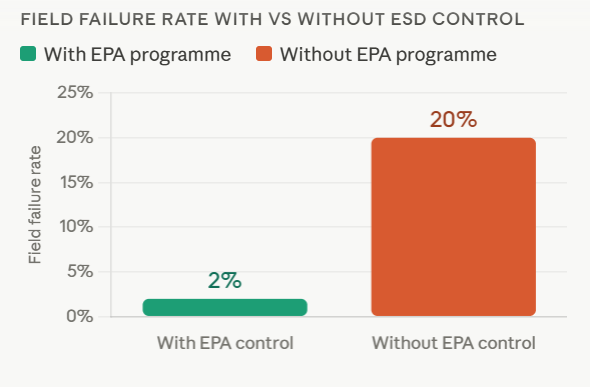
Field failure rate< 2% (with full EPA)Up to 20%+
Warranty claim costLowVery high
Customer relationship damagePreservedOften permanent

A documented case from a UK contract electronics manufacturer illustrates the structure: a production facility experienced a 20% field failure rate on an LED driver line. All units passed factory tests. After an external ESD audit identified manual handling as the root cause and full EPA implementation was completed, field failures dropped below 2%. The audit and EPA implementation cost a fraction of the warranty claims and customer relationship damage already incurred [22].

For Indian EMS units pursuing export certification (IATF 16949, AS9100, IPC-A-610), a documented ESD control programme is often a prerequisite — not an optional extra.


Section 9: What "Buffer Stock" Means in an ESD Context

A less-discussed dimension of the monsoon ESD problem is supply continuity during the rainy season.

Monsoon season in India coincides with significant logistics disruption: road flooding, port delays, and HVAC failures in transit. For components already sensitive to moisture and ESD, this creates a compound risk:

  1. Supply delays force manufacturers to pull from buffer stock
  2. Buffer stock held in inadequate conditions (temperature/humidity excursions, non-EPA warehouse) may already carry latent ESD damage
  3. Components placed on the line from damaged buffer stock produce latent failures that appear weeks after the monsoon ends
The quality of buffer stock is not just a quantity question — it's a storage condition question.

ESD-sensitive components in buffer stock should be held in:

  • ESD shielding bags (not just moisture barrier packaging)
  • Humidity-controlled environments (40–60% RH)
  • Properly grounded shelving or ESD-safe trays
  • Clearly labelled, rotated FIFO, with incoming inspection records
The alternative — a stockroom full of components that passed incoming inspection but were stored in violation of ESD conditions during a 4-month monsoon — is a slow-release quality liability.


Conclusion: The Season Is Not the Protection

India's monsoon creates a false sense of ESD safety. Outdoor humidity is high. The air feels heavy. The assumption is that static isn't a problem.

Inside the factory, the air conditioning has lowered relative humidity below the safe threshold. Components with gate oxide thicknesses measured in angstroms are being handled by operators who've loosened their ESD discipline because it feels unnecessary.

The damage is silent. It passes QC. It ships. And it fails — in the field, after the rains have long ended.

The science is settled. The standards are clear. The cost of getting this wrong compounds with every export order, every OEM customer, and every return that arrives labelled "no fault found."

The monsoon paradox is not complicated to fix. It requires measurement (not assumption), consistent protocol (not seasonal relaxation), and the right consumables in the right place at the right time.

That's exactly what ESD compliance is built for — and exactly what responsible sourcing partners in the ESD supply chain exist to support.


Data Summary: Key Numbers at a Glance

ESD damage cost (global, annually)         : $5 billion USD (ESDA estimate)

ESD as % of unknown electronics failures : 25% of all identified failures Product losses due to static (ESDA range) : 8% – 33% Latent vs. catastrophic ESD failures : ~90% latent MTBF reduction from latent ESD damage : Up to 50% Field failure reduction (post-EPA) : From ~20% to < 2% (documented case) ESD ROI (ESDA reported) : 10:1 Safe RH range (EPA) per ANSI/IEC standard : 40–60% RH Minimum safe RH per ESD TR20.20 : 30% RH Human body voltage @ <20% RH (carpet) : Up to 35,000 V Human body voltage @ >65% RH (carpet) : < 1,500 V Smallest ESD threshold (advanced MOSFET) : As low as 30 V India electronics exports FY 2024-25 : ₹3.26 lakh crore (8x growth since 2014-15) India EMS market FY25 : ~$40–45 billion India EMS projected FY30 : ~$150 billion (31% CAGR)


References

1] ESD Association (ESDA). "ESD Basics: The Cost of ESD Damage." ESD Association. [https://www.esda.org/basics/part1.cfm

2] Universal Instruments Corporation. "Challenges of Electro-Static Discharge (ESD) in the Electronics Industry." July 2015. [https://www.uic.com/challenges-of-electro-static-discharge-esd-in-the-electronics-industry/

3] Hisco Inc. "Estimating the Cost of ESD Damage." Allspec White Paper. [https://www.hisco.com/UserFiles/allspec/whitepapers/pdf/estimating-the-cost-of-esd-damage.pdf

4] ALLPCB. "The Hidden Threat: Understanding Latent ESD Damage in PCB Assembly." September 2025. [https://www.allpcb.com/allelectrohub/the-hidden-threat-understanding-latent-esd-damage-in-pcb-assembly

5] Bondline Electronics. "ESD in Modern Electronics: Risks, Myths & How to Prevent Damage." 2026. [https://bondline.co.uk/blog/esd-risk-in-modern-electronics

6] Wikipedia. "Electrostatic Discharge." [https://en.wikipedia.org/wiki/Electrostatic_discharge

7] Journal of Electrostatics. "Investigating the human sensory threshold for electrostatic discharge using current waveform measurements." ScienceDirect, 2025. [https://www.sciencedirect.com/science/article/abs/pii/S0304388625001640

8] ESD Association. ESD Handbook ESD TR20.20-2008. Section 5.3.16: Humidity. Available via ESD Association. [https://www.esda.org; also cited in: USPTO Patent 12563710, "Device for protection against electrostatic discharges in electronic components."

9] Desco Europe. "The Impact of Relative Humidity on ESD." Citing ESD TR20.20-2008 section 5.3.16. [https://vermasonesd.wordpress.com/2016/09/22/the-impact-of-relative-humidity-on-esd/

10] USPTO Patent 12563710. "Device for protection against electrostatic discharges in electronic components." [https://image-ppubs.uspto.gov/dirsearch-public/print/downloadPdf/12563710

11] JEDEC. "ANSI/ESDA/JEDEC JS-001 — Joint Standard for Electrostatic Discharge Sensitivity Testing: Human Body Model (HBM) Device Level." [https://www.jedec.org/standards-documents/docs/js-001-2023

12] RS Components. "ESD Control Programme Plan Per EN 61340-5-1." IEC 61340-5-1 Edition 2.0, 2016. [https://docs.rs-online.com/4668/0900766b81718ae2.pdf

13] InCompliance Magazine. "Electrostatic Discharge: How Important Is It?" Citing EOS/ESD Technology Roadmap. [https://incompliancemag.com/electrostatic-discharge-how-important-is-it/

14] Lin, C.-C. & Lin, C.-Y. "ESD Research of SCR Devices under Harsh Environments." MDPI Materials, September 2023. DOI: 10.3390/ma16186182. [https://www.ncbi.nlm.nih.gov/pmc/articles/PMC10532737/

15] Press Information Bureau, Government of India. "Electronics manufacturing grows sixfold, exports grow eightfold in the last 11 years." December 2025. [https://www.pib.gov.in/PressReleasePage.aspx?PRID=2199336

16] Tribune India. "India's electronics exports surged 47% in Q1 2025-26." August 2025. [https://www.tribuneindia.com/news/business/indias-electronics-export-surged-47-in-q1-2025-26-piyush-goyal

17] KPMG in India / India Shipping News. "India's Electronic Manufacturing Services (EMS) Opportunity at a Strategic Growth Juncture." June 2026. [https://indiashippingnews.com/indias-electronic-manufacturing-services-ems-opportunity-at-a-strategic-growth-juncture-kpmg-in-india-report/

18] EY India. "Why India's Electronics Manufacturing Services sector is growing." [https://www.ey.com/en_in/insights/advanced-manufacturing/why-india-s-electronics-manufacturing-services-sector-is-growing

19] InCompliance Magazine. "Fundamentals of Electrostatic Discharge — Part Six: ESD Standards." [https://incompliancemag.com/fundamentals-of-electrostatic-discharge-part-six-esd-standards/

20] KEYENCE America. "How Humidity Affects Static Electricity and What You Can Do About It." [https://www.keyence.com/products/static/resources/static-control-resources/how-humidity-affects-static-electricity-and-what-you-can-do-about-it.jsp

21] Desco Industries. "Cost of ESD Damage." Citing ESD Association. [https://www.descoindustries.com/pdf/CostofESDDamage.pdf

22] Automation Industry / ESD Protection in Manufacturing. "ESD Protection in Manufacturing: Costs, Risks & Solutions." February 2026. [https://www.automationindustry.org/why-esd-protection-matters-in-modern-manufacturing/


Published by KOLDPWR — ESD Consumables, Buffer Stock & Electronics Handling Solutions, Nagpur & Pune. For consultation on ESD compliance programs, buffer stock strategy, or ESD consumables supply for your facility, reach KOLDPWR through our website.

#ESD#electrostatic discharge#monsoon electronics damage#humidity and ESD#PCB ESD protection#ESD consumables India#electronics manufacturing India#ESD compliance#ANSI S20.20#IEC 61340#Nagpur electronics#Pune EMS#latent ESD damage#rainy season electronics#static electricity humidity