
Static Risk
For damage caused by static during the course of ordinary handling.
Choose your level of protection
Swipe tiers→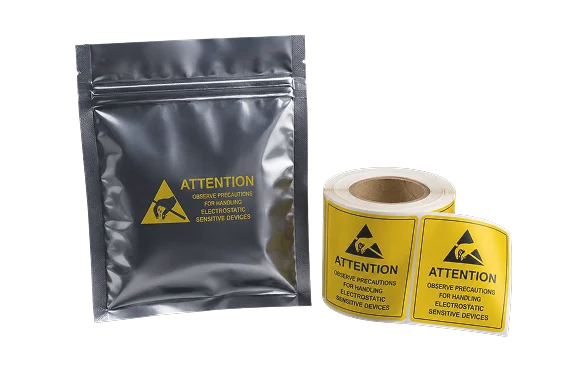
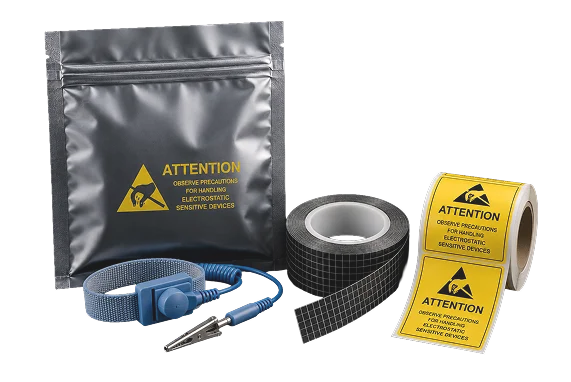
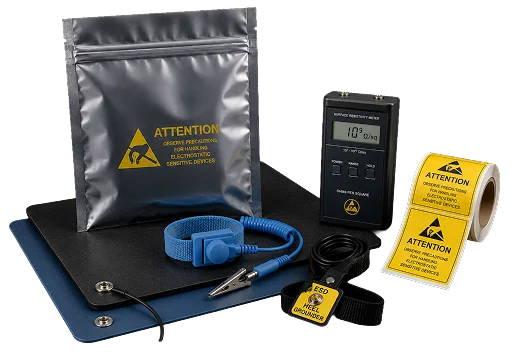
CRITICAL PROTECTION
CRITICAL PROTECTION
WHERE STATIC DAMAGE ACTUALLY SHOWS UP
Static builds up during ordinary handling - sliding a component from a tray, walking across the floor, or simply picking up a board.
Static doesn't kill a part right away. They weaken the junction, causing failure only after weeks in the field.
By the time the failure appears, the component has left the production line. There is no way to trace it back to what happened during handling.
Who This Protects
Common Questions
Q: What is the optimal surface resistivity for static shielding bags?
A: According to ANSI/ESD S541, the dissipative layer (typically the outer layer) should have a surface resistance between 10^4 and 10^11 ohms. The interior metalized layer provides Faraday cage electrostatic shielding with static discharge attenuation (<50 nJ) to protect highly ESD-sensitive parts.
Q: How often should ESD grounding wrist straps be tested on SMT lines?
A: ESD wrist straps and grounding cords should be tested daily (or continuous monitor loops utilized) before SMT handlers touch any components. Testing verifies that the system resistance remains between 7.5 x 10^5 and 3.5 x 10^7 ohms to ensure static dissipation while maintaining safety.
Related Protection Risks
Also dealing with cleanroom risk?
See Cleanroom Risk→Also dealing with warehouse risk?
See Warehouse Risk→Not sure which level fits your static risk?
Share SMT/EMS details and our custom design engineers will specify target levels for your line components.